
Calling Card Template Free
A calling card — once a Victorian visiting card, now more often a simple personal or business card — is a small printed card with your name and a way to reach you. This free template maker lets you design one in your browser, choose from classic, modern, minimal and traditional social layouts, and print ten on a sheet of US Letter or A4 card stock.
- Free to use
- No sign-up
- Runs in your browser
Calling card maker
Calling Card Design Pack
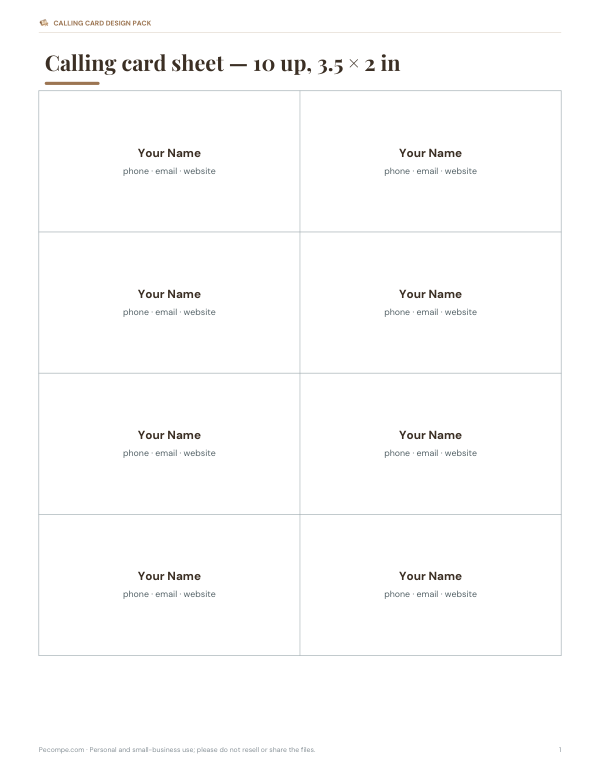
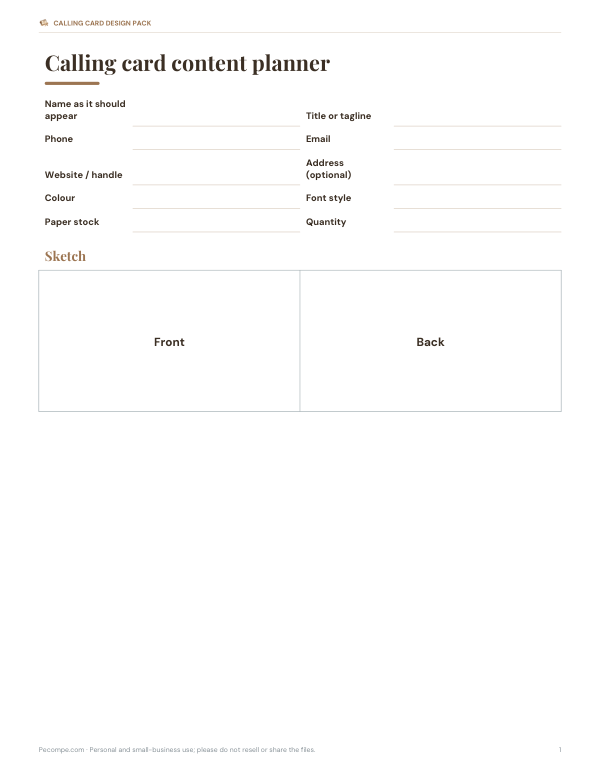
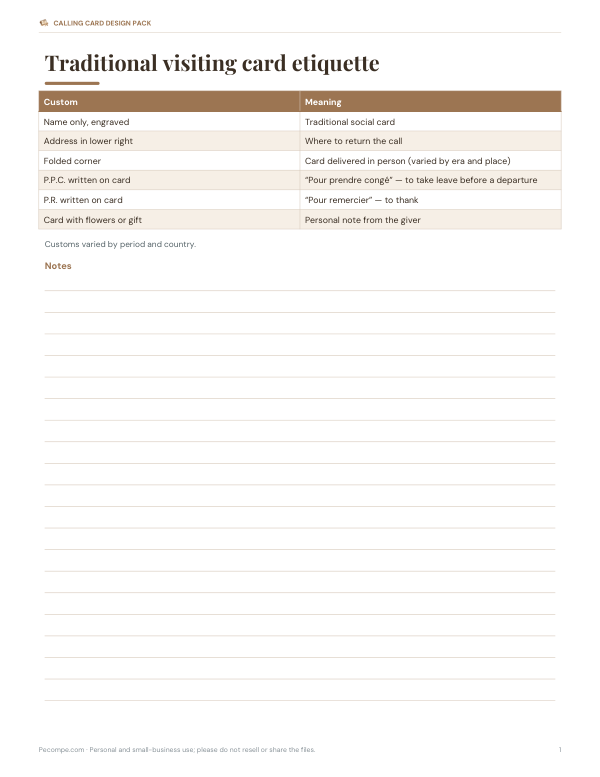
Print-ready calling card sheets: blank 10-up cutting guides for US Letter and A4, a card content planner and a guide to traditional visiting-card etiquette.
- Letter cutting guide (PDF)
- Content planner (PDF/DOCX)
- Etiquette guide (PDF)
Formats: PDF, DOCX. Instant download after payment (link valid 72 hours, up to 5 downloads). AI-assisted: the templates were drafted with AI help and reviewed and laid out before publishing.
$3.00 USD, one-time 3 files · about $1.00 each
- Instant download
- 7-day refund
- Secure checkout by Stripe
7-day money-back guarantee. Full refund within 7 days of purchase, even after you download.
Full refund within 7 days — see the refund policy and license.
Free printables
Single sheets you can print right now, no sign-up. The full pack adds every sheet in one download plus the editable files.
Using the template
- Type your name and the details you want on the card — leave fields blank to hide them.
- Pick a layout, accent colour and font style.
- Check the preview, which is proportioned like a standard 3.5 × 2 inch card.
- Choose US Letter or A4 and print the sheet of ten.
- In the print dialog, set scale to 100% (“actual size”) and margins to none if available.
- Cut along the crop marks with a paper trimmer or a craft knife and ruler.
Everything happens in your browser: the details you type are not uploaded or saved. Download the SVG if you want to open the design in another program or send it to a print shop.
What is a calling card?
In the 18th and 19th centuries, a calling card (or visiting card) was a small engraved card with a person’s name, left when paying a social call. Etiquette books described elaborate rules: cards were left on a silver tray in the hall, the corner of a card might be folded to show it had been delivered in person, and married women often carried their own cards alongside their husbands’. A traditional social card showed only the name — sometimes with an address in the lower corner — engraved in a script or serif typeface on heavy white or ivory card.
Today “calling card” is often used interchangeably with business card or personal contact card, and the term also refers to prepaid telephone cards. The “Traditional social” layout recreates the name-only style; the others are modern contact cards.
Standard card sizes
| Region | Size | Notes |
|---|---|---|
| US and Canada | 3.5 × 2 in (88.9 × 50.8 mm) | Used by this template |
| Europe (ISO-style) | 85 × 55 mm | Common in much of Europe |
| UK / Ireland | 85 × 55 mm | Similar to European size |
| Japan | 91 × 55 mm | Meishi |
| China | 90 × 54 mm | Common size |
| Traditional social cards | Often smaller, e.g. about 3 × 1.5 in for men and larger for women | Historically varied by etiquette guide |
This template uses the 3.5 × 2 inch size for both paper options so the sheet layout stays 2 across and 5 down. A4 sheets have slightly wider margins.
Choosing paper for home printing
- Use card stock of about 80–110 lb cover (roughly 216–300 gsm) — check your printer’s maximum paper weight.
- Matte card stock is easiest to print on with inkjet printers; glossy stock may smudge.
- Pre-perforated business card sheets save cutting but must match the layout; check their margins against a test print on plain paper.
- Print a test page on ordinary paper first and hold it against the card stock to check alignment.
- For a traditional social card, choose white or ivory heavyweight stock and a serif font.
What to include
| Card type | Typical content |
|---|---|
| Personal / social | Name, and optionally phone, email or social handle |
| Freelance | Name, what you do, phone, email, website or portfolio |
| Small business | Business name, your name and role, contact details, website |
| Networking / events | Name, one-line description, a single preferred contact and a portfolio link |
| Traditional visiting card | Name only, perhaps an address |
Less is usually more on a small card: two or three contact methods are easier to read than six. Keep text at least 8 points in size and leave white space around the edges — at least 1/8 inch (3 mm) — so nothing is trimmed off.
Printing tips
Browsers add their own headers, footers and margins by default; turn these off in the print dialog for accurate placement. If the cards come out slightly off-centre, it is usually the printer’s paper feed — adjust by printing a test sheet and measuring. Laser printers generally handle card stock and crisp small text well; inkjet prints need a few minutes to dry before cutting. For a large quantity or special finishes such as foil, letterpress or rounded corners, download the SVG and ask a print shop for a quote, sending them the full-size design and asking about bleed requirements.
Worked example
A freelance photographer wants cards for a craft fair. She enters her name, “Landscape Photographer”, a phone number, email and portfolio website, picks the modern layout with a deep blue accent and the sans-serif font, and prints two Letter sheets on 100 lb matte cover stock — twenty cards. Cutting with a paper trimmer along the crop marks takes about ten minutes. For a wedding thank-you instead, she might switch to the traditional social layout with just her name in italic serif on ivory card.
Etiquette today
- Offer a card when someone asks how to reach you, or at the end of a conversation, rather than at the start.
- In Japan and parts of East Asia, cards are exchanged with both hands and read before being put away respectfully.
- Tucking a personal card into a gift or flowers is a modern echo of the visiting card tradition.
- Keep cards clean and flat in a card holder; a creased card makes a poor impression.
Frequently asked questions
Is the calling card template really free?
Yes. You can design, print and download the SVG without paying or signing up.
What size is a calling card?
This template uses the standard US size of 3.5 × 2 inches; European cards are usually 85 × 55 mm.
What is the difference between a calling card and a business card?
Traditionally a calling card was a social card with just a name; business cards include work contact details. Today the terms overlap.
What paper should I print on?
Card stock of about 80–110 lb cover (216–300 gsm), within your printer’s limits.
Why are my cards misaligned when printed?
Set scale to 100% with no browser headers or margins, and check your printer’s paper feed with a test sheet.
Are my details uploaded?
No. Everything stays in your browser.